 Blogs How to Build a Loan Origination System for NBFCs
How to Build a Loan Origination System for NBFCs
The Loan Origination System is the engine that determines how fast your NBFC can take a borrower from application to disbursement. This guide breaks down the complete LOS architecture, how to configure a Business Rule Engine for your credit policy, how to integrate multi-bureau and alternative data through the Account Aggregator, and how AI credit scoring works in practice for India's lending market.
 22 Sept 2026
 12 minutes read time
If you have read our guide on why NBFCs must build a digital lending system in 2026, you already understand the strategic imperative. This guide goes one level deeper into the technical architecture that makes it real.
The Loan Origination System manages everything from the moment a borrower submits an application to the moment a credit decision is made and the loan moves to documentation and disbursement. Getting this right is what separates an NBFC that disburses in 30 minutes from one that still takes 5 days to issue a sanction letter.
What a Loan Origination System Actually Does
A Loan Origination System automates the complete pre-disbursement journey. It handles application intake across all channels, identity verification and KYC, financial data collection via the Account Aggregator, multi-bureau credit checks, credit decisioning through a Business Rule Engine and AI scorecard, document execution via eSign, and handoff to the Loan Management System for disbursement.
According to TheDigitalFifth's technical guide for lending CTOs, a well-designed LOS should achieve a straight-through processing rate of 60 to 70 percent for pre-approved and repeat borrower segments, meaning the majority of applications move from submission to disbursement with zero manual intervention.
For payday, salary, and personal loan NBFCs processing high volumes of small-ticket applications, this STP rate is the foundation of unit economics. Every manual touchpoint in the origination process adds cost and time that accumulates rapidly at scale.
LOS Architecture
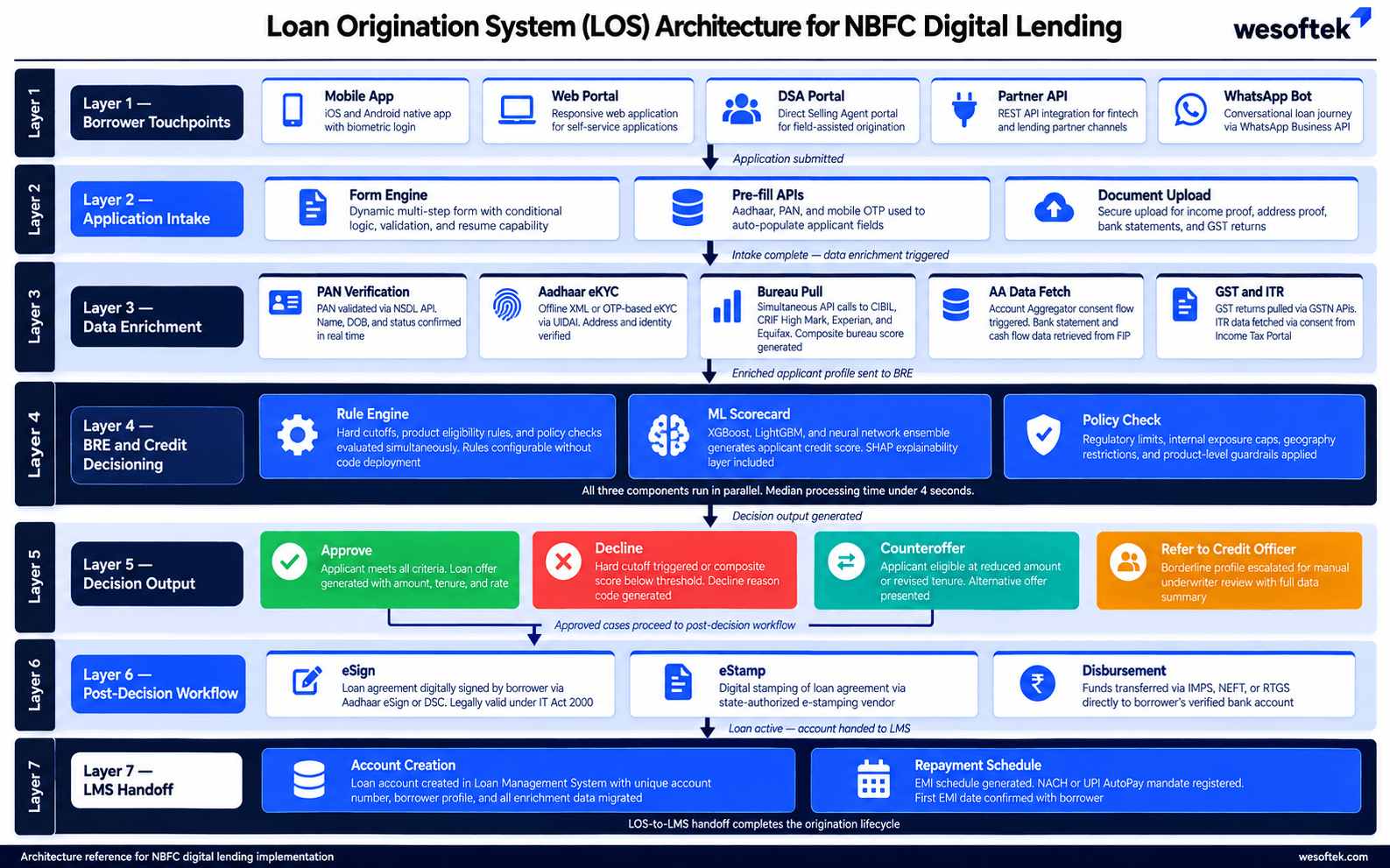
Layer 1: Borrower Touchpoints and Acquisition Channels
Every LOS must serve multiple acquisition channels simultaneously without creating separate data silos for each:
| Channel | Primary Borrower Segment | Key Requirement |
|---|---|---|
| Mobile App | Retail, payday, salary loan borrowers | Sub-3-minute application completion |
| Web Portal | MSME, self-employed, housing finance | Desktop-optimized with document upload |
| DSA Partner Portal | All segments via intermediary | Commission tracking, application status, performance dashboard |
| Embedded Lending API | Partner platform users | White-label flow, real-time decisioning |
| WhatsApp and SMS | Tier 2 and Tier 3 borrowers | Conversational application, vernacular support |
For NBFCs targeting payday and salary loan segments, the mobile app experience is the primary competitive differentiator. Borrowers in this segment decide whether to complete an application within the first 30 seconds of the experience. Every unnecessary field or screen is a dropout point.
Layer 2: Application Intake and Intelligent Pre-fill
Manual data entry is the first point of abandonment in any digital loan application. A well-designed intake layer eliminates most of it through API-driven pre-fill:
| Data Point | Pre-fill Source | What the Borrower Does |
|---|---|---|
| Name, date of birth, address | NSDL PAN verification API | Enter PAN number only |
| Aadhaar-linked address | Aadhaar OTP eKYC | Give OTP consent |
| Bank account and cash flow | Account Aggregator consent | Approve AA consent request |
| Employment and salary | AA bank statement or employer API | Confirm displayed details |
| Existing loan obligations | Bureau pull | Consent to bureau check |
| GST turnover for MSME | Account Aggregator | Approve AA consent |
| ITR income for self-employed | Account Aggregator | Approve AA consent |
The goal for any retail loan application is to reduce mandatory manual fields to fewer than five. Every additional field increases abandonment probability.
Layer 3: Data Enrichment and Verification
Once intake is complete, the system must enrich and verify the data before passing it to the credit decisioning engine. This layer runs multiple API calls in parallel to minimize processing time:
- PAN and Aadhaar cross-verification for identity confirmation
- Bank account ownership verification via penny drop or account validation API
- Bureau data pull from one or more credit bureaus
- Account Aggregator financial data fetch
- GST and ITR data pull for business borrowers
- Device fingerprint and fraud signal collection
- Geo-verification and serviceable area confirmation
All of this should complete in under 60 seconds for a standard retail loan application.
Multi-Bureau Integration
India has four active credit bureaus, each capturing different borrower populations and loan histories. An NBFC relying on a single bureau makes credit decisions with incomplete data.
| Bureau | Primary Strength | Best Used For |
|---|---|---|
| CIBIL | Largest individual credit database in India | Primary check for all retail and personal loans |
| CRIF High Mark | Microfinance, rural, and SHG lending | MFI borrowers, self-help group members, rural segments |
| Experian India | Strong thin-file and new-to-credit coverage | Young borrowers and first-time credit applicants |
| Equifax India | Broad retail and MSME coverage | Cross-validation and NTC borrower confirmation |
Best practice is to run a minimum of two bureau checks per application simultaneously, not sequentially. The BRE then applies segment-specific weights to each bureau's output rather than treating all bureau scores equally.
For microfinance companies and NBFCs with SHG borrower bases, CRIF High Mark captures MFI loan histories that CIBIL may not reflect. Skipping CRIF in this segment means missing critical repayment behavior data.
Discuss Multi-Bureau Integration and BRE Architecture with Wesoftek
The Business Rule Engine
The Business Rule Engine is the component that converts your credit policy into automated lending decisions. It is also the component most NBFCs underinvest in, which is why so many systems require constant manual overrides for cases that should have been handled automatically.
For a complete technical guide on BRE architecture, configuration, and product-specific rule design, read: What Is a Business Rule Engine and Why Every NBFC Needs One
What the BRE Evaluates
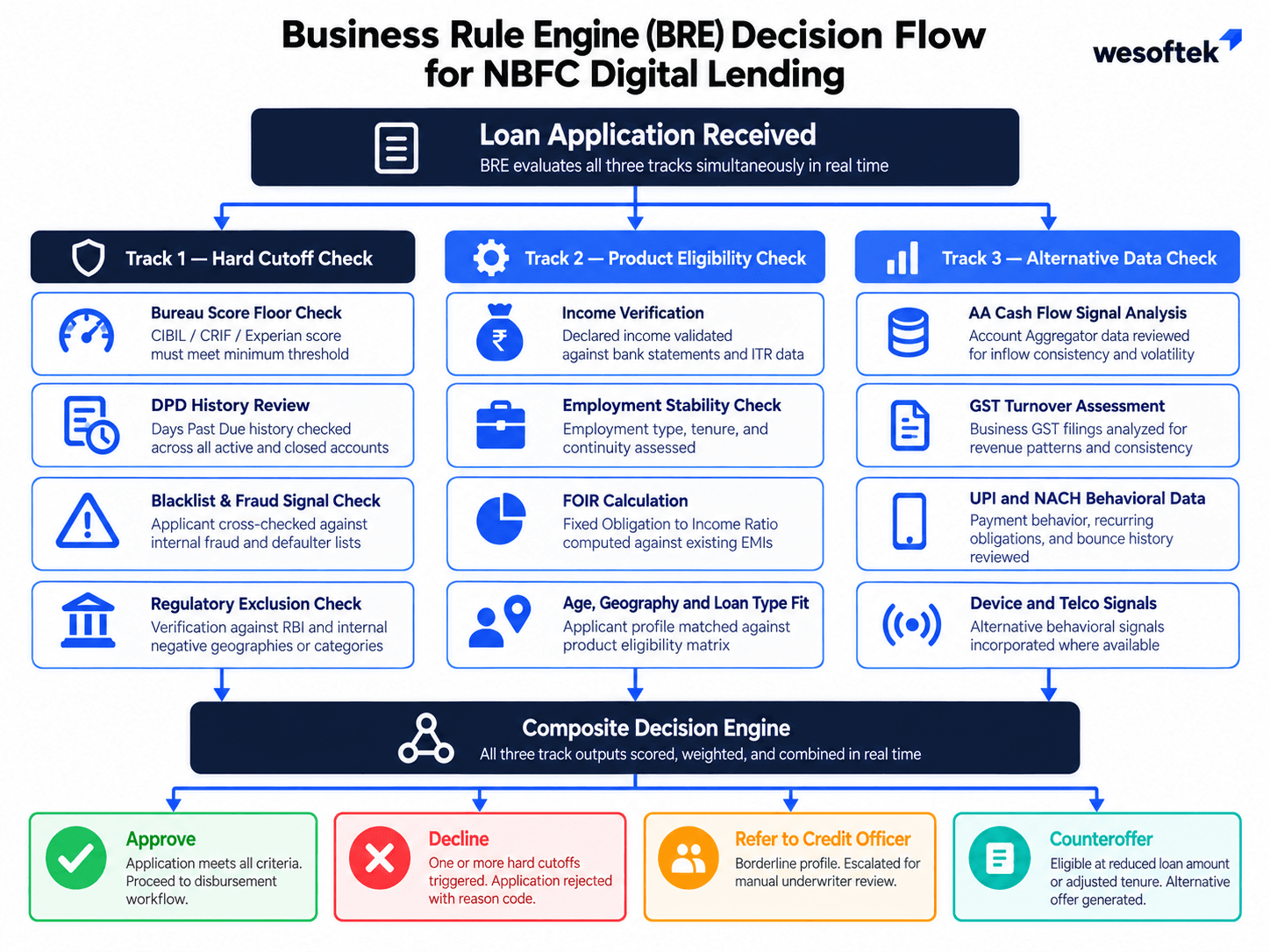
| Rule Category | Example Rules | Data Source |
|---|---|---|
| Hard cutoffs | Minimum CIBIL score of 650, no active DPD above 30 days, not on internal or industry blacklist | Bureau, internal negative database |
| Income eligibility | Minimum net monthly income of INR 15,000, FOIR not exceeding 55 percent | AA bank statement, employer verification API |
| Product constraints | Maximum loan amount of INR 5 lakhs for first-time borrowers in personal loan product | Internal credit policy |
| Geography rules | Serviceable pin codes and states for current collection infrastructure | Internal serviceable area database |
| Fraud detection signals | New device flag, geo-anomaly between declared address and IP location, multiple applications from same device | Device fingerprint, IP geolocation |
| Bureau-specific rules | No settled or written-off account in last 36 months, maximum two active unsecured loans | Bureau report |
| Employment-specific rules | Minimum employment vintage of 6 months for salaried, minimum business vintage of 24 months for MSME | Employer API, GST registration date |
BRE Configurability: The Most Critical Design Requirement
Credit policies change frequently. Portfolio data reveals unexpected default patterns. RBI issues updated guidance. New products launch. A BRE that requires developer involvement to change a credit rule creates compliance risk and slows down product iteration.
The BRE must allow credit managers to configure rules through a visual rule editor without engineering involvement. This is the single most important requirement to validate when selecting or building any LOS.
Account Aggregator Integration
The Account Aggregator framework, supported by Sahamati and now connected to over 100 financial institutions, has fundamentally changed how NBFCs collect and verify financial data.
Instead of requesting physical bank statements, salary slips, or ITR documents, the LOS sends a consent request to the borrower's AA app. Once approved, financial data flows directly from the borrower's bank (Financial Information Provider) to the NBFC (Financial Information User) in a structured, machine-readable format that the BRE and credit engine process immediately.
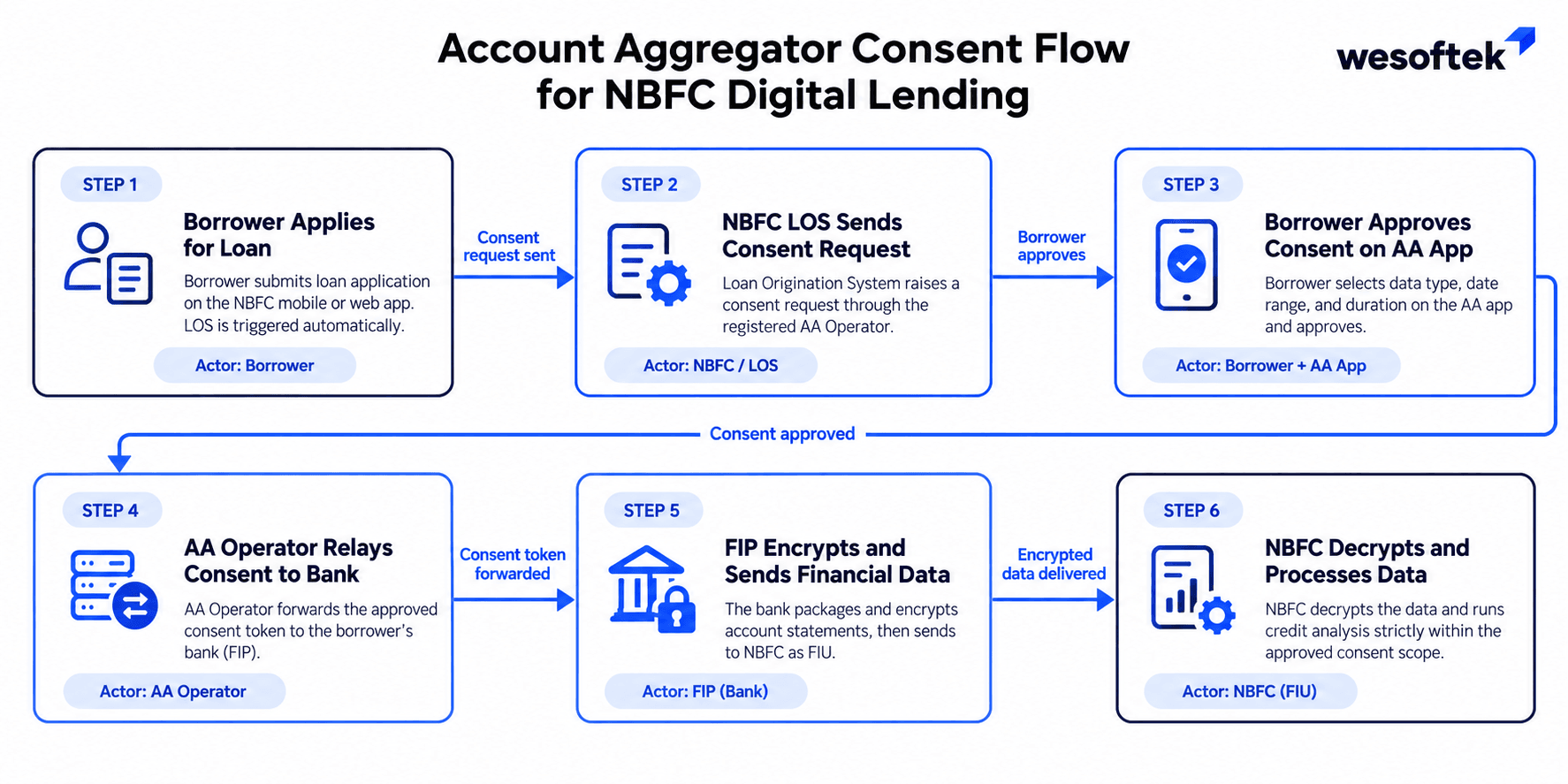
| Data Available via Account Aggregator | Primary Lending Use |
|---|---|
| Bank account statements up to 3 years | Cash flow analysis, income verification, EMI payment track record |
| Mutual fund portfolio | Asset verification, loan against mutual fund eligibility assessment |
| GST returns | Business turnover and compliance history for MSME loans |
| ITR data | Declared income verification and tax compliance track record |
| Equity and demat holdings | Asset base assessment for secured lending |
| Insurance policies | Existing financial commitment mapping |
The fraud prevention benefit of AA integration is equally significant. Because data flows directly from regulated financial institutions without borrower intermediation, it cannot be altered or fabricated. This eliminates one of the most common fraud vectors in unsecured lending: inflated bank statement submissions.
KYC Integration
KYC is a mandatory compliance requirement under the RBI KYC Master Direction. It is also one of the most common points of application abandonment when implemented with too much friction.
| KYC Mode | Use Case | Regulatory Basis | Integration Partners |
|---|---|---|---|
| Aadhaar OTP eKYC | Personal loans, payday loans, salary loans | RBI KYC Master Direction | Signzy, HyperVerge, Digitap |
| Video KYC (V-CIP) | Loans above certain thresholds, MSME loans, housing finance | RBI V-CIP circular | Signzy, HyperVerge |
| DigiLocker document fetch | Supplementary document verification for all loan types | RBI KYC Master Direction | DigiLocker API |
| Offline Aadhaar XML | Where OTP eKYC is not possible | RBI KYC Master Direction | Signzy, internal parser |
| Penny drop account verification | Bank account ownership confirmation | Best practice, not RBI-mandated | Razorpay, PayU, Easebuzz |
The KYC module must run asynchronously where possible. A borrower who completes eKYC should not wait for the KYC result to start the bureau pull. Both should run in parallel to compress overall origination time.
AI Credit Scoring
Traditional bureau scores fail a significant portion of India's creditworthy population. Self-employed professionals, gig workers, first-time borrowers, and MSME owners often carry thin credit files despite demonstrating strong repayment capacity through their financial behavior.
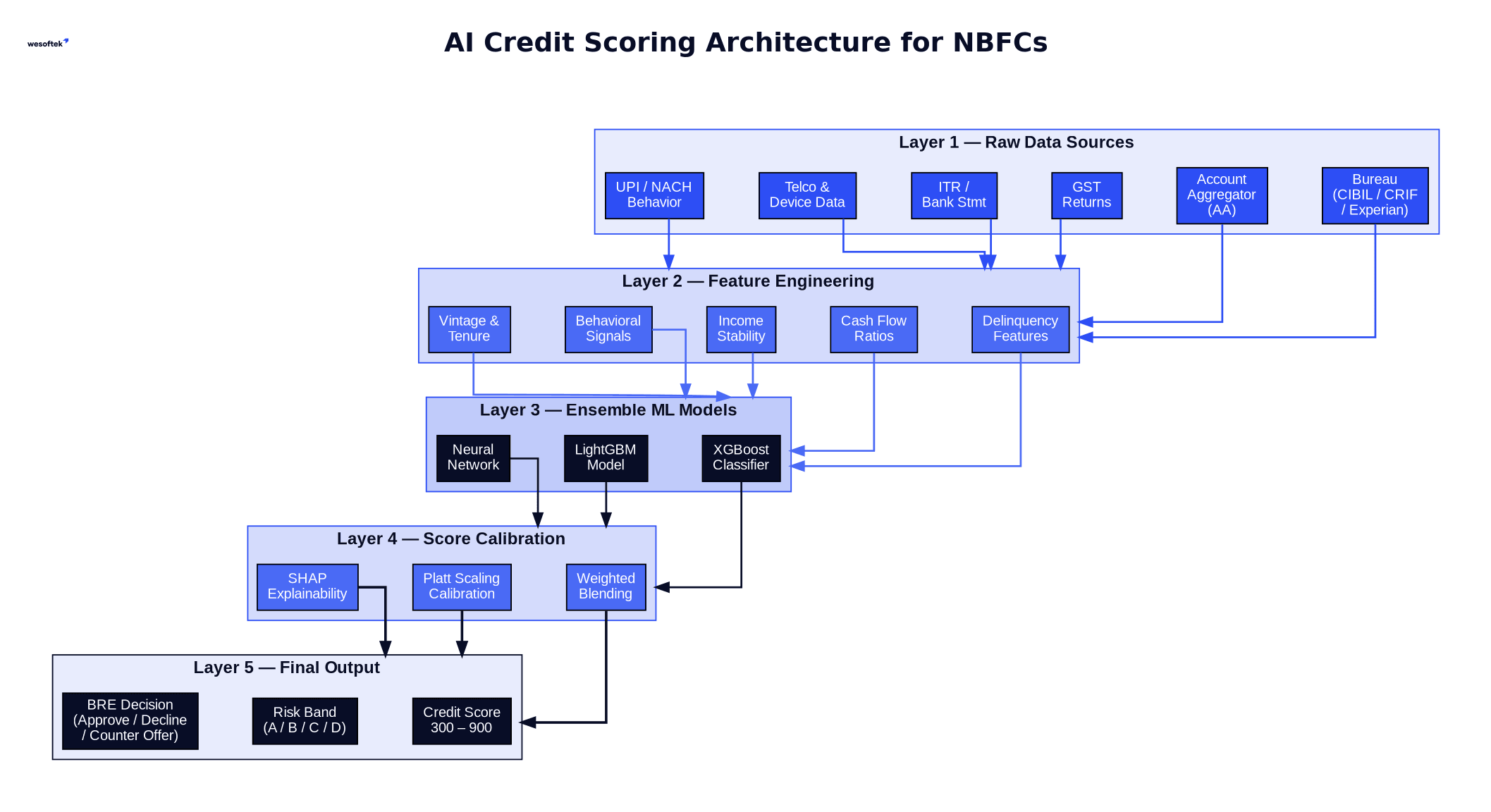
| Data Source | What It Reveals | Feature Examples for ML Model |
|---|---|---|
| Bank statement via AA | Cash flow, income stability, spending behavior | Average monthly credit, salary regularity, existing EMI-to-income ratio |
| GST returns via AA | Business turnover, seasonality, compliance | Quarterly revenue trend, GST filing regularity, turnover growth |
| ITR data via AA | Declared income, tax compliance | Income growth rate, gap between reported and actual cash flow |
| Telecom data | Payment behavior, device ownership | Recharge frequency, prepaid vs postpaid status, device value |
| Device signals | Digital literacy, fraud risk | New device flag, device age, location consistency |
NVIDIA's financial services research demonstrates that ensemble ML models combining structured financial data with behavioral signals consistently outperform single-model approaches in both approval accuracy and default prediction, particularly for thin-file borrower segments.
Credit Scorecard Weight Distribution
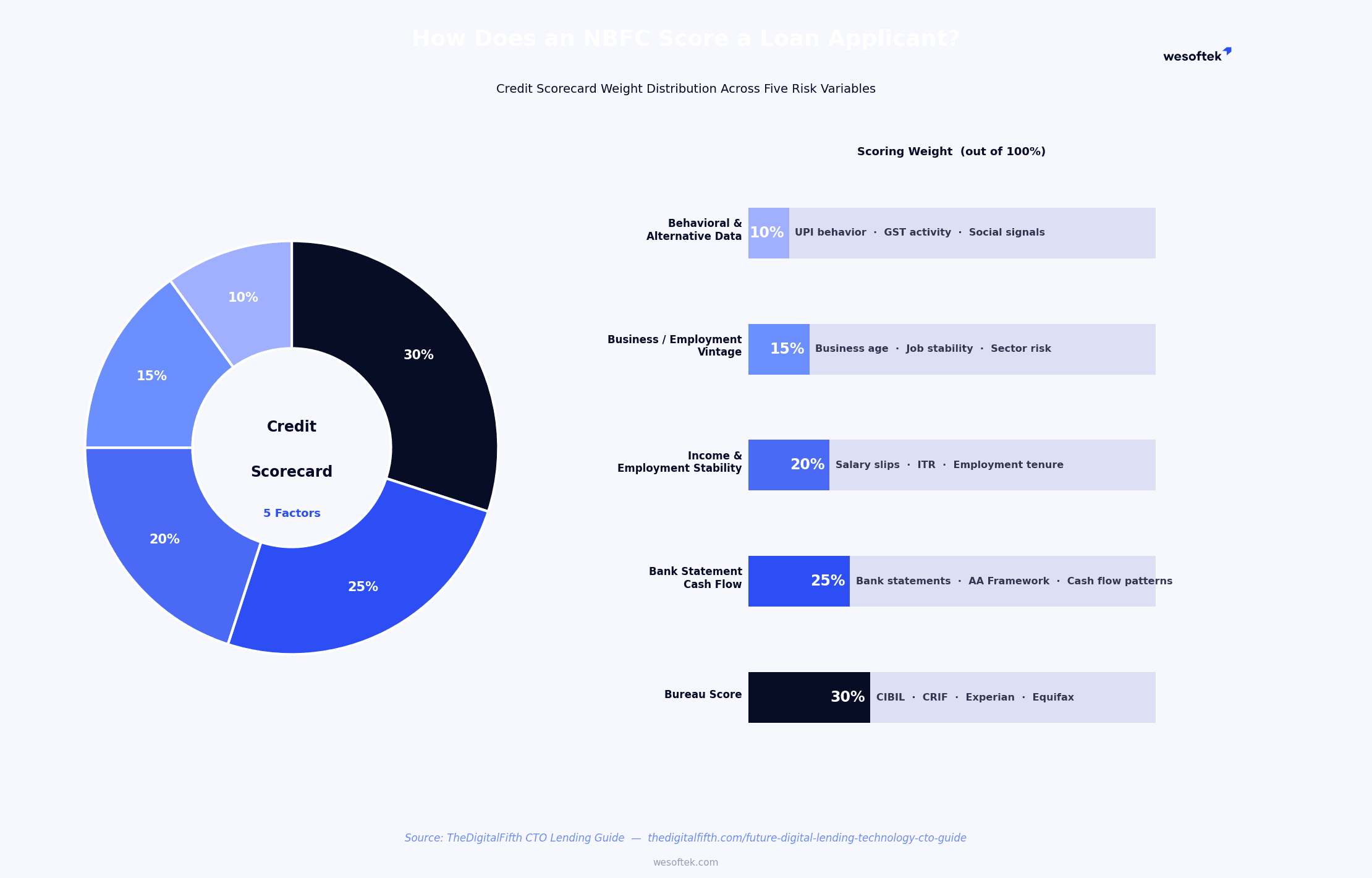
| Scoring Variable | Typical Weight | Primary Data Source |
|---|---|---|
| Bureau Score (CIBIL or Experian) | 25 to 35 percent | Credit bureau API |
| Bank Statement Cash Flow Analysis | 20 to 30 percent | Account Aggregator |
| Income Stability and Regularity | 15 to 20 percent | AA plus ITR plus GST |
| Employment or Business Vintage | 10 to 15 percent | GST registration plus employer API |
| Existing Obligations and FOIR | 10 to 15 percent | Bureau plus bank statement |
| Behavioral and Alternative Data | 5 to 10 percent | Telco plus device plus ecommerce |
Post-Decision Workflow
Once the BRE and AI scorecard produce an approval, the system must move the loan to disbursement without reintroducing manual steps.
| Step | Technology | Partner Options | Time Target |
|---|---|---|---|
| Loan agreement generation | Dynamic template engine with borrower data | Internal engine | Under 5 seconds |
| eSign execution | Aadhaar OTP eSign via licensed ESP | Digio, Signzy | Under 2 minutes |
| eStamp (where required) | State-specific eStamp integration | Digio, legal tech partners | Under 5 minutes |
| Disbursement | IMPS, NEFT, or UPI to verified account | Razorpay, PayU, Easebuzz | Instant to 2 hours |
| LMS account creation | Automated handoff post eSign | Internal LMS integration | Under 30 seconds |
| Repayment schedule generation | LMS schedule engine | Internal LMS | Under 10 seconds |
| NACH mandate registration | E-NACH via net banking or debit card | Razorpay, PayU, Easebuzz | Same day |
Per RBI Digital Lending Guidelines, the borrower must receive a Key Fact Statement before loan execution, and a cooling-off period must be available to the borrower after disbursement. Both must be enforced programmatically within the LOS workflow.
Discuss Your Loan Origination System Architecture with Wesoftek
What This Connects To
The LOS does not operate in isolation. It is the front end of a complete digital lending infrastructure. Understanding how the LOS connects to adjacent systems is essential for designing the architecture correctly:
-
Business Rule Engine: The BRE is the decision core of the LOS. For a complete technical breakdown of BRE design, configuration, and product-specific rules, read: What Is a Business Rule Engine and Why Every NBFC Needs One
-
Payday and Salary Loan Products: If you are building a small-ticket, high-volume lending platform, the LOS requirements differ from standard personal or MSME loans. Read: How to Build a Payday and Salary Loan Platform for NBFCs
-
RBI Compliance and Infrastructure: Every LOS must be built on an infrastructure that meets RBI Digital Lending Guidelines, VAPT requirements, and DR/DC standards. Read: RBI Compliance, VAPT, and DR/DC Architecture for NBFC Lending Platforms
-
Overall digital lending strategy: For the strategic overview of where the LOS fits in a complete digital lending system, start with: Why NBFCs Must Build a Digital Lending System in 2026
Conclusion
The Loan Origination System is the most visible part of a digital lending platform to both borrowers and credit teams. A well-built LOS compresses origination time, improves approval accuracy, eliminates document fraud, and creates the data foundation that makes AI credit scoring better over time.
Every design decision in the LOS compounds. A mobile interface that reduces dropout by 10 percent. A BRE that raises STP rate by 15 percent. An AI scorecard that improves approval accuracy by 12 percent. These gains multiply across every loan the NBFC originates.
NBFCs that invest in getting the LOS architecture right from the beginning build a platform that grows stronger with every loan. Those that bolt on improvements to a poorly designed foundation spend years managing technical debt instead of managing growth.
Plan Your LOS Architecture with Wesoftek's FinTech Engineering Team
Frequently Asked Questions
-
What is the difference between a Loan Origination System and a Loan Management System? The LOS manages everything before disbursement: application intake, KYC, credit decisioning, documentation, and eSign. The LMS manages everything after disbursement: repayment schedules, EMI collection, DPD tracking, NPA classification, and loan closure. The two systems must be tightly integrated so the LMS account is created automatically the moment the LOS completes disbursement.
-
How long does it take to build a production-ready LOS for an NBFC? A production-ready LOS with multi-bureau integration, Account Aggregator connectivity, eKYC, BRE, and automated disbursement typically takes 3 to 5 months to build and deploy depending on product complexity, team size, and regulatory approval timelines. Simpler payday and personal loan LOS implementations can go live faster. MSME and housing finance LOS builds typically take longer due to additional document types and workflow complexity.
-
Can an NBFC use a SaaS LOS instead of building a custom one? Yes, but with important tradeoffs. SaaS LOS platforms offer faster time to market but limited configurability for credit policy, product design, and integration depth. NBFCs with complex credit products, high volumes, or specific regulatory requirements typically outgrow SaaS platforms and face costly migrations. We cover this decision in detail in our comparison guide on custom LOS vs SaaS lending platforms.
-
How does the Account Aggregator reduce fraud in lending? Because AA data flows directly from regulated financial institutions to the NBFC without the borrower touching or transmitting the data, it cannot be altered or fabricated. A borrower who submits a physical bank statement can modify transaction entries. The same data fetched via AA consent is cryptographically signed and tamper-evident. This eliminates the most common document fraud vector in unsecured lending.
-
What KYC partners does Wesoftek integrate with for LOS implementations? Wesoftek integrates with Signzy, HyperVerge, and Digitap for eKYC and Video KYC, Digio for eSign and eStamp, and Razorpay, PayU, and Easebuzz for payment and NACH mandate management. All integrations are production-tested and RBI-compliant.
-
How does AI credit scoring improve on traditional bureau-only underwriting? Traditional bureau scores only capture formal credit history. A significant portion of India's creditworthy population has thin bureau files despite strong financial behavior. AI models trained on alternative data from the Account Aggregator, GST returns, ITR data, and behavioral signals can approve creditworthy borrowers that bureau-only systems would decline, while also detecting high-risk borrowers with inflated bureau scores but poor underlying cash flow.

Neeraj Raisinghani
I've always enjoyed understanding how things work, whether it's a product, a business, a process, or an idea. Curiosity has led me to explore different fields, ask countless questions, and continuously learn from the people and experiences around me. I don't believe learning is limited to a profession or a single interest. Every conversation, challenge, and opportunity offers a chance to discover something new, and that's the mindset I try to carry with me every day.
Recent Blogs
 14 Sept 202610 minutes read time
Why NBFCs Must Build a Digital Lending System in 2026: The Complete Strategic Guide
India's NBFCs are facing a fundamental choice: build a complete digital lending infrastructure or continue losing ground to platforms that already have one. This guide breaks down the market forces driving this shift, the four-stage lending value chain every NBFC must digitize, and a practical transformation roadmap for where to start.
22 Sept 202612 minutes read timeHow to Build a Loan Origination System for NBFCs
The Loan Origination System is the engine that determines how fast your NBFC can take a borrower from application to disbursement. This guide breaks down the complete LOS architecture, how to configure a Business Rule Engine for your credit policy, how to integrate multi-bureau and alternative data through the Account Aggregator, and how AI credit scoring works in practice for India's lending market.
 14 May 202615 minutes read time
The Future of Smart Healthcare
Healthcare is no longer just about treating illness. It is increasingly about predicting it, preventing it, and managing it continuously inside hospitals, at home, and everywhere in between.
Schedule a Meeting with Our Experts
Share a brief about your project and get a guaranteed response within 24 hours.