 Blogs Why NBFCs Must Build a Digital Lending System in 2026: The Complete Strategic Guide
Why NBFCs Must Build a Digital Lending System in 2026: The Complete Strategic Guide
India's NBFCs are facing a fundamental choice: build a complete digital lending infrastructure or continue losing ground to platforms that already have one. This guide breaks down the market forces driving this shift, the four-stage lending value chain every NBFC must digitize, and a practical transformation roadmap for where to start.
 14 Sept 2026
 10 minutes read time
There is a particular kind of NBFC that still processes loans the way it did a decade ago. Relationship managers collect documents. Credit teams review files manually. Disbursements wait on bank confirmation emails. Collections depend on field agents and post-dated cheques.
These NBFCs are not failing yet. But they are falling behind in ways that will be difficult to reverse.
On the other side of the market, a different kind of NBFC is originating loans in under 30 minutes, underwriting with AI-powered scorecards, and collecting repayments automatically through NACH and UPI AutoPay without a single outbound call.
The gap between these two types of lenders is not a gap in ambition. It is a gap in infrastructure.
This guide explains what that infrastructure looks like, why 2026 is the critical year to build it, and how NBFCs of every size can approach the transformation systematically.
The Market Is Moving Faster Than Most NBFCs Realize
According to Grand View Research, the global digital lending platform market was valued at USD 12.1 billion in 2023 and is projected to grow at a compound annual growth rate of 24.3 percent through 2030. In India, the trajectory is even steeper.
The RBI Working Group on Digital Lending documented that digital lending in India grew more than twelve times in the five years preceding 2022. The Global FinTech Fest 2026 confirmed that India's Digital Public Infrastructure, including Aadhaar, UPI, DigiLocker, and the Account Aggregator network, has now created the conditions for every NBFC to operate at digital scale regardless of geography or borrower segment.
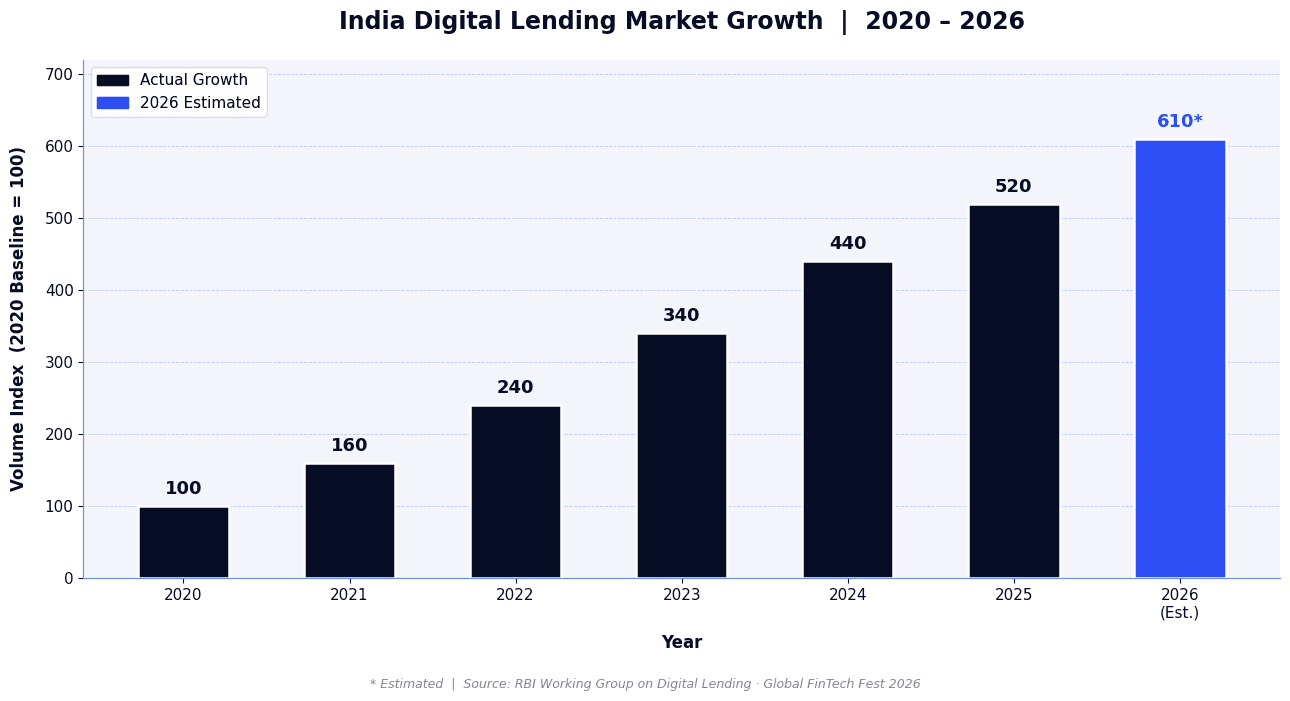
According to Decentro's digital lending analysis, the Indian digital lending market is expected to reach USD 350 billion by 2030, driven by MSME credit demand, consumer finance growth, and the rapid expansion of embedded lending through fintech partnerships.
As EY's digital lending research highlights, financial institutions that invest in end-to-end digital lending infrastructure consistently report stronger portfolio quality, faster time-to-market for new products, and significantly lower cost-per-loan compared to those operating on legacy systems.
What a Digital Lending System Actually Means
The term digital lending is used loosely. Many NBFCs believe they have a digital lending system because borrowers can submit an application form online. That is not a digital lending system. That is a digital intake form attached to a manual process.
A genuine digital lending system automates every stage of the lending lifecycle without requiring manual intervention for standard cases.
| What Most NBFCs Have | What a Real Digital Lending System Delivers |
|---|---|
| Online application form | Automated LOS with pre-fill from PAN, Aadhaar, and Account Aggregator |
| Manual credit review | AI-powered BRE with multi-bureau integration and ML scorecard |
| Physical or emailed documents | DigiLocker fetch, Video KYC, eSign, and eStamp |
| Manual disbursement approval | Automated disbursal via IMPS or UPI post eSign |
| PDC or field agent collection | NACH mandate and UPI AutoPay with automated retry logic |
| Monthly MIS in Excel | Real-time portfolio dashboard with early warning signals |
| Ad-hoc compliance reporting | Automated regulatory reporting and full audit trail |
The Four Stages Every NBFC Must Digitize
A complete digital lending system addresses four distinct stages of the lending lifecycle. Digitizing one or two while leaving others manual creates bottlenecks that limit the entire operation.
[DIAGRAM NEEDED: Four-Stage Digital Lending Value Chain — Horizontal flow diagram with four labeled boxes connected by arrows: Stage 1 Customer Outreach and Acquisition, Stage 2 Credit Review and Decisioning, Stage 3 Documentation and Disbursement, Stage 4 Servicing and Portfolio Management. Each box lists its three to four key components and shows a primary output] Source: RBI Working Group on Digital Lending
Stage 1: Customer Outreach and Acquisition
This stage determines how borrowers discover your NBFC and begin the application journey. Digital acquisition channels include mobile apps, web portals, DSA partner portals, API-based embedded lending within partner platforms, and conversational flows via WhatsApp and SMS.
For payday, salary, and personal loan NBFCs targeting ticket sizes under INR 10 lakhs, the acquisition channel is often the single biggest competitive differentiator. Borrowers in this segment decide within seconds whether the experience is worth completing.
Stage 2: Credit Review and Decisioning
This is where the Business Rule Engine, AI credit scoring, and bureau integrations come together to produce a decision without human intervention for eligible cases. A well-configured BRE pulls bureau data from CIBIL, CRIF High Mark, Experian, and Equifax, applies product-specific eligibility rules, runs alternative data signals from the Account Aggregator, and produces an approve, decline, or counteroffer decision in seconds.
We cover the full technical architecture of this stage in: How to Build a Loan Origination System for NBFCs
For a dedicated deep dive on the BRE specifically, read: What Is a Business Rule Engine and Why Every NBFC Needs One
Stage 3: Documentation and Disbursement
Once a credit decision is made, the documentation journey must be equally automated. This includes eKYC and Video KYC through partners such as Signzy, HyperVerge, or Digitap, eSign via Digio, eStamp for applicable states, and automated disbursement via IMPS, NEFT, or UPI directly to the borrower's verified bank account.
Per the RBI Digital Lending Guidelines, all disbursements must flow from a regulated entity's bank account directly to the borrower. No pass-through arrangements via lending service providers are permitted.
For NBFCs building payday and salary loan platforms specifically, read: How to Build a Payday and Salary Loan Platform for NBFCs
Stage 4: Servicing and Portfolio Management
This stage covers everything post-disbursement: EMI collection via NACH and UPI AutoPay, DPD tracking, NPA classification per RBI IRAC norms, prepayment and foreclosure handling, and collections for delinquent accounts. The Loan Management System is the operational engine for this entire stage.
Poor LMS design is the most common reason NBFCs with strong origination capabilities end up with rising NPAs. Collection automation and early warning systems are not optional at scale.
Why 2026 Is the Right Year to Build
Three conditions that rarely align are all present in India's lending market right now.
Regulatory clarity exists. The RBI Digital Lending Guidelines of 2022 established clear rules for how digital lending must operate. NBFCs building today know exactly what compliance looks like. We cover this in detail in: RBI Compliance, VAPT, and DR/DC Architecture for NBFC Lending Platforms
Infrastructure is mature. The Account Aggregator network, supported by Sahamati and connected to over 100 financial institutions, has eliminated physical bank statements from most lending workflows. DigiLocker makes document verification instant. UPI and NACH make collections fully automated.
Technology is accessible. AI-powered credit scoring, cloud infrastructure, and API-based KYC integrations are no longer exclusive to large technology companies. NBFCs of every size can access production-grade technology through the right development partner.
As Federal Bank's digital lending analysis notes, NBFCs that delay digital infrastructure investment beyond 2026 risk entering a market where borrower expectations and competitor capabilities have moved so far ahead that catching up requires significantly greater investment and time.
Discuss Your NBFC Digital Transformation Roadmap with Wesoftek
The NBFC Digital Lending Transformation Roadmap
Most NBFCs cannot rebuild their entire lending infrastructure simultaneously. A phased approach delivers business value at each stage while building toward a complete system.
| Phase | Timeline | Key Deliverables | Primary Business Outcome |
|---|---|---|---|
| Phase 1: Foundation | Months 1 to 3 | Cloud infrastructure, core LMS, bureau integrations, basic LOS | Digital operational backbone in place |
| Phase 2: Digital Origination | Months 4 to 6 | Full LOS with eKYC, AA integration, BRE, eSign, automated disbursal | End-to-end paperless origination live |
| Phase 3: Intelligent Operations | Months 7 to 9 | AI credit scoring, ML fraud detection, NACH collections, NPA monitoring | Significant reduction in OpEx and credit losses |
| Phase 4: Ecosystem Integration | Months 10 to 12 | Embedded lending APIs, co-lending module, partner portal, BI dashboards | Platform-level distribution capabilities |
Traditional vs Digital: The Operational Gap in Numbers
| Metric | Traditional NBFC | Digital-First NBFC |
|---|---|---|
| Loan Processing Time | 5 to 15 days | 20 to 60 minutes |
| Document Collection | Physical or courier | DigiLocker or AA pull |
| Credit Decision | Manual plus single bureau | Automated BRE plus multi-bureau plus AI |
| Disbursement Speed | 24 to 72 hours | Real-time via IMPS or UPI |
| Repayment Collection | Field agent or PDC | NACH plus UPI AutoPay |
| Fraud Detection | Post-incident review | Real-time ML prevention |
| Cost per Loan | High baseline | 60 to 70 percent lower |
| NPA Detection | Monthly MIS review | Continuous ML early warning |
| Scalability | Linear and headcount-driven | Exponential and platform-driven |
Stripe's analysis of digital lending confirms that digital-native lenders consistently achieve lower NPA ratios and higher approval-to-disbursement conversion rates compared to lenders using fragmented or legacy systems.
This Blog Is Part of a Five-Part Series
This is the first guide in Wesoftek's complete NBFC digital lending series. Each guide covers a specific layer of the technology stack:
| Blog | Topic | Link |
|---|---|---|
| Blog 2 | How to Build a Loan Origination System for NBFCs | Read Now |
| Blog 3 | What Is a Business Rule Engine and Why Every NBFC Needs One | Read Now |
| Blog 4 | How to Build a Payday and Salary Loan Platform for NBFCs | Read Now |
| Blog 5 | RBI Compliance, VAPT, and DR/DC Architecture for NBFCs | Read Now |
Conclusion
Building a digital lending system is not a technology decision. It is a strategic decision about where your NBFC wants to be positioned in a market that is transforming faster than most leadership teams appreciate.
The four stages of the lending value chain, from customer acquisition to portfolio management, each require specific technology components that must work together as a coherent system. Point solutions and patchwork integrations create operational debt that compounds over time.
TurnKey Lender's review of 2026 lending trends identifies AI-driven underwriting, embedded finance distribution, and real-time collections as the capabilities separating market leaders from followers in this window.
The NBFCs that will define the next decade of Indian lending are those investing in complete infrastructure today. Not the largest. Not the oldest. The ones that recognized the window and moved decisively within it.
Start Your Digital Lending Platform Assessment with Wesoftek
Frequently Asked Questions
- What is the difference between a digital lending system and a loan management system?
A Loan Management System is one component within a complete digital lending system. It manages the post-disbursement lifecycle: repayment schedules, EMI collection, NPA tracking, and loan closure. A full digital lending system also includes the LOS for origination, the BRE for credit decisioning, KYC modules, and collections automation all working as an integrated platform.
- Which types of NBFCs benefit most from building a digital lending system?
NBFCs in high-volume, small-ticket segments benefit most immediately: payday lending, salary loans, personal loans under INR 10 lakhs, and consumer finance. However, housing finance companies, equipment finance NBFCs, and microfinance institutions also gain significantly through faster origination, better credit assessment, and automated collections.
- How long does it take to build a complete digital lending system?
A production-ready platform covering LOS, BRE, KYC integration, LMS, and NACH collections typically takes 6 to 12 months from design to go-live depending on scope and team. A phased approach can deliver the first working stage within 3 months, allowing the NBFC to begin operating digitally while the full platform is completed.
- Is Account Aggregator integration mandatory for digital lending?
The Account Aggregator framework is not mandatory by regulation but is effectively essential for competitive operation. NBFCs using AA report significantly faster processing times, lower document fraud rates, and higher straight-through processing rates compared to those still collecting physical bank statements.
- What RBI regulations apply to NBFC digital lending platforms?
The primary framework is the RBI Digital Lending Guidelines of September 2022, supplemented by the RBI KYC Master Direction and the RBI IT Framework for NBFCs. We cover compliance requirements in full in Blog 5 of this series.
Recent Blogs
14 Sept 202610 minutes read timeWhy NBFCs Must Build a Digital Lending System in 2026: The Complete Strategic Guide
India's NBFCs are facing a fundamental choice: build a complete digital lending infrastructure or continue losing ground to platforms that already have one. This guide breaks down the market forces driving this shift, the four-stage lending value chain every NBFC must digitize, and a practical transformation roadmap for where to start.
No date12345
 14 Mar 202610 minutes read time
Generative AI in Healthcare
A new age of opportunities in several fields and sectors has been brought about by the development of generative AI. This constantly developing technology has the power to fundamentally alter how we approach and resolve difficult issues, providing previously unthinkable breakthroughs and inventive solutions.
Schedule a Meeting with Our Experts
Share a brief about your project and get a guaranteed response within 24 hours.