 Blogs What Is a Business Rule Engine and Why Every NBFC Needs One
What Is a Business Rule Engine and Why Every NBFC Needs One
This guide explains what a BRE is, why hard-coded decisioning fails NBFCs specifically, and how a well-implemented BRE connects directly to loan book quality, origination cost, and RBI compliance readiness.
 29 Sept 2026
Every rejection your NBFC processes costs money three times. The lender pays for the bureau pull and fraud check that led nowhere. The merchant or channel partner pays in lost conversion. The borrower pays in eroded trust and walks away. A Business Rule Engine (BRE) is the layer that stops this from happening at scale, by moving the eligibility filter upstream, before costs are incurred and before borrowers hit friction.
Yet most NBFCs in India still embed their credit policy inside application code. Every threshold change becomes an engineering ticket. Every regulatory update becomes a sprint item. Every new product launch waits on IT. The BRE exists precisely to break that dependency.
If you are evaluating your full lending stack, read Custom LOS vs SaaS for NBFCs first to understand where BRE fits within the broader technology architecture.
What Is a Business Rule Engine?
A Business Rules Engine (BRE) is a software layer that separates decision logic from application code. It lets credit and risk teams define, test, and deploy the conditions that govern a business process without writing or modifying source code.
In lending, the process is credit decisioning: who qualifies, at what amount, under what terms, and why. The BRE evaluates every application against the current version of your credit policy and returns an outcome, approve, decline, or refer for manual review, along with a traceable record of which rules fired.
The architecture is simple: inputs come in (bureau data, bank statements, GST, applicant profile), rules are evaluated in a defined sequence, and a decision comes out. What changes with a BRE is not what gets decided but who controls the logic and how fast it can change.
The core distinction:
| Model | Who Controls Policy | Time to Change a Rule |
|---|---|---|
| Hard-coded rules | Engineering team | 2 to 6 weeks (dev + QA + deploy) |
| Business Rule Engine | Credit and risk team | Hours to 1 day |
According to McKinsey and Company, financial institutions using automated decision engines have reduced loan processing times by up to 60% while improving underwriting accuracy by 30%.
Why Hard-Coded Rules Fail NBFC Credit Teams
Many NBFCs still run credit policy inside code written directly into their Loan Origination System or a custom decisioning script. This creates a pattern that is well-documented across Indian lenders: policy decisions are delayed because every change requires developer involvement.
Consider what happens when the RBI issues updated guidance on risk weights for unsecured retail loans. A traditional NBFC must:
- Brief the technology team on what changed and why.
- Wait for a developer to scope, code, and test the logic change.
- Schedule a production deployment window.
- Validate that the change did not break adjacent logic.
That cycle typically runs three to six weeks. In a market where borrowers expect instant decisions and co-lending partners operate on tight turnaround windows, a month-long policy lag is a competitive and compliance liability simultaneously.
The same bottleneck appears every time a credit head wants to tighten a bureau score cutoff after early delinquency signals, adjust FOIR thresholds for a new geography, or launch a product variant with different eligibility criteria. Each of these changes, no matter how minor, competes for the same engineering capacity as unrelated feature work.
The Real Cost of a Wrong Decision
[DIAGRAM PLACEMENT: Triple-cost rejection diagram] Designer note: Recreate the Juspay HyperCredit "Every rejection is paid for three times" concept. Three-column card layout on a light grey background. Top: a horizontal timeline with five points — Checks eligibility, Fills details, Bureau pull, Fraud check, "Not eligible" — with red dots at Bureau pull and Fraud check labeled "COST INCURRED." Bottom: three white cards side by side.
- Card 1 (red bullet): LENDER PAYS — "Underwriting cost spent to reach a rejection. 2 signals pulled, 0 originations."
- Card 2 (red bullet): MERCHANT PAYS — "A basket abandoned at checkout. Conversion dip the next morning."
- Card 3 (red bullet): USER PAYS — "Trust spent on a journey that failed loudly. 67% drop off when they hit friction." Alt text: Diagram showing three parties who pay the cost of a single late-stage loan rejection: lender, merchant, and borrower. Caption: Every rejection that happens after bureau pull and fraud check has already cost two parties real money before the decision lands. SEO filename: nbfc-bre-triple-rejection-cost-diagram.png
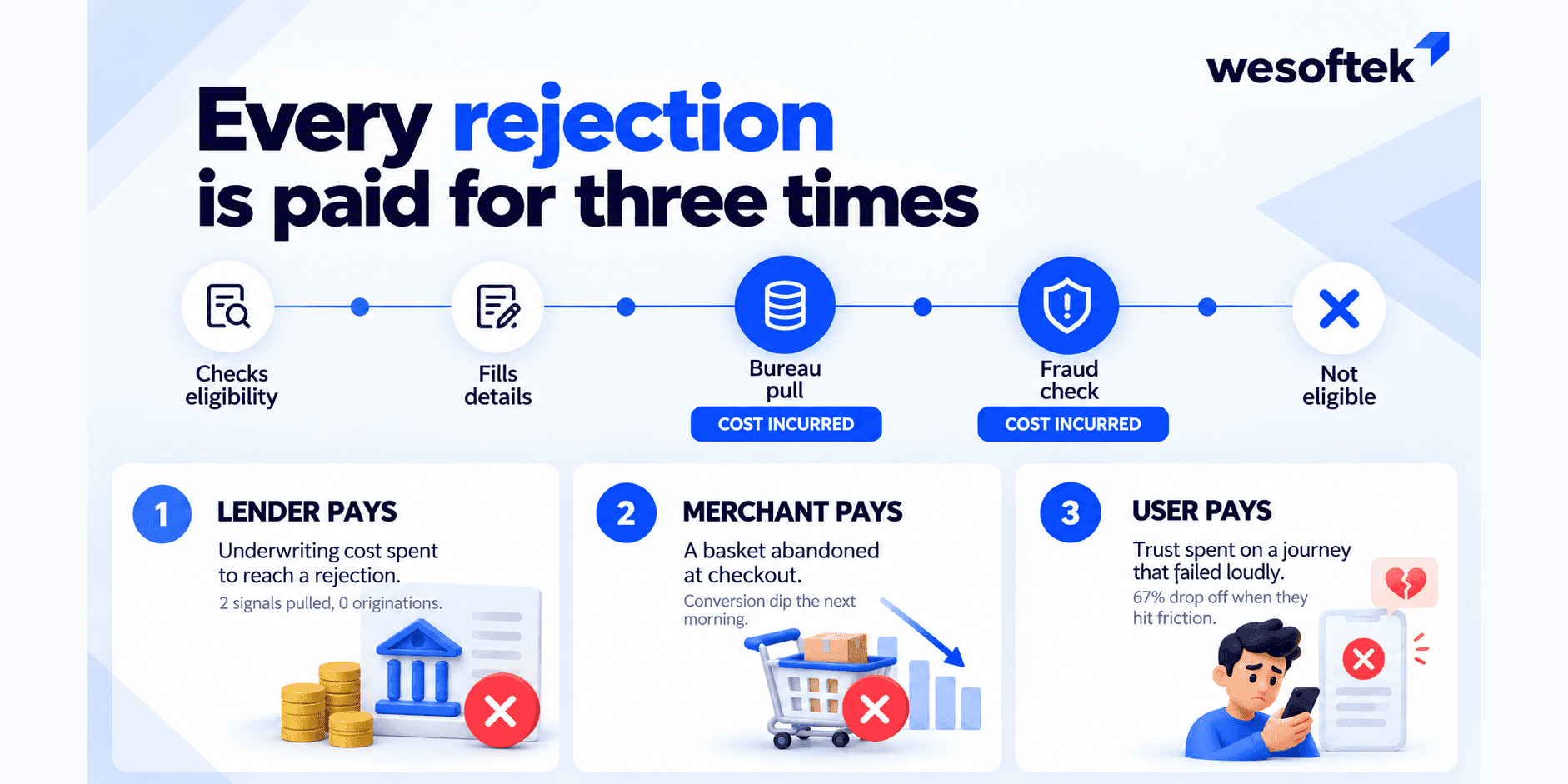
The numbers make this concrete. According to Juspay's HyperCredit research:
- Pre-qualified leads convert at 3 to 5 times the rate of unqualified ones.
- Moving the eligibility filter upstream cuts cost per origination by approximately 50%.
- 67% of borrowers drop off when they encounter friction mid-journey.
CRIF High Mark reports that NBFCs implementing governed rule engines have seen decision time reduce by up to 50% and accuracy improve by 30%.
How a BRE Actually Works: Three Evaluation Tracks
A well-designed BRE for NBFCs does not run a single linear check. It runs parallel evaluation tracks and combines their outputs into a composite decision.
[DIAGRAM PLACEMENT: Three-track BRE decision flow] Designer note: Three vertical columns, each representing one track, feeding into a single output box at the bottom. Use blue for Track 1, green for Track 2, and purple for Track 3. Each column contains 3 to 4 stacked rule nodes. Arrows converge at a "Composite Decision Engine" box showing three possible outputs: Approve, Decline, Refer.
- Track 1 (Hard Cutoff Check): Bureau score threshold, DPD check, fraud watchlist, negative geography
- Track 2 (Product Eligibility Check): Loan amount vs income, FOIR threshold, product vintage rules, co-lending partner criteria
- Track 3 (Alternative Data Check): GST turnover trend, bank statement bounce rate, AA consent data, ITR consistency Alt text: Three-track BRE decision flow for NBFC credit underwriting, showing hard cutoffs, product eligibility, and alternative data evaluated in parallel before a composite decision. Caption: Modern NBFC BRE architecture evaluates three tracks simultaneously before producing a final approve, decline, or refer outcome. SEO filename: nbfc-bre-three-track-decision-flow-diagram.png
Track 1: Hard Cutoff Check
These are binary elimination rules. If a bureau score falls below a defined threshold, if a borrower appears on a fraud watchlist, or if there is a DPD (Days Past Due) flag that exceeds policy limits, the application exits immediately. No further evaluation is required and no additional bureau or AA cost is incurred.
Track 2: Product Eligibility Check
Applications that pass hard cutoffs move to product-level evaluation. This is where FOIR (Fixed Obligation to Income Ratio), loan-to-income multiples, employer category rules, and co-lending partner criteria are applied. Different products run different rule sets simultaneously from a single engine.
Track 3: Alternative Data Check
For thin-file applicants or MSME borrowers, bureau data alone is insufficient. The third track evaluates GST return trends, Account Aggregator (AA) bank statement patterns, ITR consistency, and mobile intelligence signals. A BRE that treats AA data as a first-class input — rather than an afterthought — gives NBFCs a materially faster path to underwriting new-to-credit segments.
BRE vs Manual Underwriting: The Operational Comparison
| Dimension | Manual Underwriting | Business Rule Engine |
|---|---|---|
| Policy change turnaround | Weeks, tied to engineering sprint | Hours for approved configuration changes |
| Who controls the logic | Developers, IT team | Credit and risk team directly |
| Audit trail | Scattered across code commits and emails | Centralized version history per rule |
| Testing before go-live | Full regression cycle | Rule-level simulation on historical data |
| Traceability per decision | Requires code archaeology | Rule path visible per application |
| Regulatory response time | Sprint required | Days for approved changes |
| STP rate potential | Low (manual bottlenecks) | High (70 to 90% straight-through processing possible) |
| Consistency across channels | Variable (human judgment differs) | Uniform (same logic across all touchpoints) |
According to Oxyzo, implementing a BRE framework across their lending lifecycle resulted in a 30% reduction in manual underwriting time and a 40% improvement in operational efficiency.
Tech-Controlled vs Business-Led Decisioning
This is the structural shift that a BRE enables.
[DIAGRAM PLACEMENT: Tech-Controlled vs Business-Led Decisioning model] Designer note: Recreate the two-panel FinBox Sentinel diagram. Left panel (blue border, labeled "TECH-CONTROLLED DECISIONING"): vertical flow — Risk Team → Product Team → Developers → Testing Team → Deployment. Bottom row: Slow Launches, IT Dependency, Limited Agility icons. Right panel (purple border, labeled "BUSINESS-LED DECISIONING"): vertical flow — Risk Team → Visual Rule Builder → Sandbox Testing → Governance Review → Deployment. Bottom row: Faster Decisions, Business Ownership, Continuous Optimization icons. Centre circle (dashed border): "DECISIONING GAP — Delays, dependencies and missed opportunities." Bottom banner: "Business teams own outcomes. Business teams should own decisions." Four icons: Greater Agility, Faster Innovation, Stronger Governance, Better Outcomes. Alt text: Side-by-side comparison of tech-controlled vs business-led credit decisioning models for NBFCs using a Business Rule Engine. Caption: The BRE shifts rule ownership from IT to the credit and risk team, collapsing the decisioning gap between policy intent and production execution. SEO filename: nbfc-bre-tech-controlled-vs-business-led-decisioning.png
In a tech-controlled model, the risk team defines a policy, explains it to a product manager, who explains it to a developer, who codes it, which is then tested before being deployed. At every handoff, intent can be lost and time is consumed.
In a business-led model, the risk team uses a visual rule builder to configure the policy directly, runs sandbox tests against historical portfolio data, routes for governance review, and deploys. The developer is removed from the critical path of routine policy changes.
This is not about removing technology teams from the picture. It is about reserving engineering capacity for genuinely complex infrastructure work rather than one-line threshold changes.
Champion-Challenger Testing: How NBFCs Reduce Policy Change Risk
Changing a live credit policy without visibility into its impact is how portfolios develop unexpected NPA concentrations. Champion-challenger testing is the mechanism that prevents this.
The current, proven policy (the champion) continues to serve the majority of applications. A new rule set or model (the challenger) is evaluated against a smaller, randomized slice of live traffic simultaneously. After a defined period, the risk team compares approval rate, default rate, and yield between the two versions using statistically comparable data.
For NBFCs running co-lending or BC/DA (Business Correspondent/Direct Assignment) arrangements, this is especially valuable. Partner banks often require performance data before approving a policy change. Champion-challenger results provide that evidence without committing the full book.
[DIAGRAM PLACEMENT: Champion-Challenger Testing flow] Designer note: Horizontal funnel split. At top, label: "Live Application Traffic." Arrow splits into two paths: left path (60-70% of traffic) labeled "Champion Policy (Current)" flows to a green "Approve/Decline" box; right path (30-40% of traffic) labeled "Challenger Policy (New)" flows to an orange "Approve/Decline" box. Both feed into a "Performance Comparison" analytics box at the bottom showing metrics: Approval Rate, Default Rate, Yield. Final arrow pointing right: "Winner Promoted to Full Traffic." Use a navy and teal colour scheme. Alt text: Champion-challenger testing flow diagram showing how NBFCs split live traffic between current and new credit policies before full rollout. Caption: Champion-challenger testing lets credit teams validate a policy change on real traffic before committing the full book to it. SEO filename: nbfc-bre-champion-challenger-testing-flow.png
Key BRE Capabilities Every NBFC Should Evaluate
[DIAGRAM PLACEMENT: Four-quadrant BRE capability evaluation framework] Designer note: Recreate the FinBox four-quadrant capability wheel. Central circle: "BUSINESS RULES ENGINE — The core of agile, governed decisioning." Four quadrants in a 2x2 grid:
- Top Left (01 BUSINESS OWNERSHIP, blue): Business-user rule authoring, Role-based access and control, Policy visibility and traceability
- Top Right (02 DECISIONING CAPABILITY, purple): Advanced rule logic (tables, trees, expressions, scores), Testing, simulation and what-if analysis, Decision orchestration and routing, Real-time execution
- Bottom Left (03 ARCHITECTURE, light blue): API-first and integration flexibility, Modular and reusable design, Scalability and performance, Cloud-ready and deployment options
- Bottom Right (04 GOVERNANCE, dark purple): Auditability and full traceability, Version control and change management, Access control and segregation of duties, Deployment controls and approvals Bottom banner: "THE RIGHT ENGINE ENABLES — Faster Policy Changes, Greater Flexibility, Stronger Governance, Better Decisions and Outcomes, Sustainable Business Impact." Alt text: Four-quadrant framework for evaluating Business Rule Engine capabilities for NBFCs: business ownership, decisioning capability, architecture, and governance. Caption: The right BRE for an NBFC must score well across all four quadrants, not just on automation speed. SEO filename: nbfc-bre-capability-evaluation-four-quadrant-framework.png
| Capability | Why It Matters for NBFCs |
|---|---|
| No-code/low-code rule authoring | Credit teams update policy without IT tickets |
| Champion-challenger testing | Validate new rules on live traffic before full rollout |
| Rule-level explainability | Every decision traceable to the specific rule that fired |
| India-first data integrations | Native bureau (CIBIL, CRIF, Experian, Equifax), AA, GST, ITR |
| ML model orchestration | Scorecards and deterministic rules coexist and version together |
| Audit trail and version control | Full history of who changed what, when, and why |
| Maker-checker approval workflow | High-impact rule changes require defined sign-off before deployment |
| Simulation on historical data | Impact of a policy change visible before it touches production |
The 2026 Global AI in Financial Services Report, published by the Cambridge Centre for Alternative Finance in partnership with the Bank for International Settlements and the World Economic Forum, found that 79% of regulators considered explainability important or critical, while only 50% of financial institutions reported using explainability methods. A BRE makes the deterministic part of credit decisions fully traceable, which directly addresses this gap.
Talk to Wesoftek About Designing Your NBFC Credit Policy Layer
BRE and RBI Compliance Readiness
The RBI's Digital Lending Guidelines place clear obligations on regulated entities around fair lending, explainability, and audit readiness. A BRE is not a substitute for a compliance program, but it is the infrastructure that makes compliance operationally sustainable.
Specifically, a well-governed BRE supports:
Adverse Action Explanations: Every declined application can be traced to the specific rule node that triggered rejection, enabling clear, factually accurate decline reason codes for the applicant.
Version-Controlled Policy History: If a supervisor asks for a complete timestamped history of every credit rule change over the past twelve months, the BRE produces it directly. Without a BRE, this requires reconstructing changes from code commits, emails, and meeting notes.
Maker-Checker Controls: High-impact rule changes route through a defined approval chain before deployment. This documents who authorized a policy change and when, which is the kind of evidence regulators expect during examination.
Model Governance alongside Rules: Where ML models contribute to credit decisions, the BRE can enforce hard eligibility gates that ML outputs feed into. This creates a hybrid architecture where the model handles risk scoring and the BRE enforces deterministic policy boundaries, each auditable separately.
The Reserve Bank of India's framework for NBFCs underscores the importance of robust internal controls and documentation of credit decisions. A governed BRE directly supports both requirements.
Wesoftek builds custom BRE-integrated LOS and credit decisioning platforms for NBFCs, working with your preferred data vendors and rule architecture rather than locking you into a single vendor's ecosystem. Explore NBFC Technology Consulting from Wesoftek
How to Know If Your BRE Needs to Change
Five indicators that your current decisioning layer is limiting your NBFC:
1. A policy change feels like a project. If adjusting a bureau score cutoff requires a change request, a sprint, QA, and a deployment window, your rule engine has become a bottleneck.
2. Specialists author rules, not credit teams. If the people who understand credit policy cannot write rules directly, intent is being lost in translation at every change cycle.
3. Product launches miss their window. If your credit logic is the last item on the critical path for a new product or festive season campaign, the engine is pacing the business rather than enabling it.
4. Audit requests require forensic reconstruction. If a compliance audit requires pulling logs from IT and reconciling them against documentation, your traceability is insufficient for regulatory expectations.
5. Challenger policies cannot be tested without full deployment. If you cannot evaluate a new rule set against a slice of live traffic before committing the full book, you are absorbing unnecessary change risk.
As Celusion Technologies observes, many NBFCs find that their enterprise decisioning platforms have become systems they serve rather than tools that serve them. The shift from tech-controlled to business-led decisioning is not a technology upgrade. It is an architectural choice about who owns policy and at what speed that ownership can be exercised.
Conclusion
A Business Rule Engine is not an automation tool. It is an organizational decision about where credit policy lives, who controls it, and how fast it can change.
For NBFCs operating in India's current environment, tighter RBI oversight, rising underwriting costs, pressure on portfolio quality, and borrower expectations for instant decisions, the BRE is the layer that determines whether your credit team is reactive or proactive.
When built correctly, it connects directly to loan book quality through consistent policy enforcement, origination cost through upstream eligibility filtering, and regulatory readiness through versioned, traceable, auditable decision records. When absent or hard-coded, it means every policy change is a sprint item and every audit is a reconstruction exercise.
The NBFCs that are reducing cost per origination, shortening TAT, and maintaining audit-ready decisioning infrastructure are doing so because their credit teams own the rules, not because their engineering teams are faster.
Frequently Asked Questions
1. What is the difference between a BRE and a Loan Origination System?
A Loan Origination System (LOS) manages the end-to-end workflow of a loan application from submission to disbursement. A Business Rule Engine is the decision layer within or alongside the LOS that evaluates whether an application meets policy criteria and what outcome to return. A BRE can be embedded inside a LOS or operate as a connected service that the LOS calls via API at defined decision points.
2. Does implementing a BRE require replacing our existing LOS?
No. A well-designed BRE integrates with your existing LOS via API. The rule engine receives input data from the LOS, evaluates the policy, and returns a decision that the LOS acts on. Migration of rule logic from hard-coded systems to a configurable BRE layer is a separate exercise from LOS replacement.
3. How does a BRE handle Account Aggregator data under the RBI AA framework?
A BRE that supports AA-based decisioning can ingest structured, consent-based bank statement and GST data directly from Financial Information Providers. Rules can then evaluate cash flow metrics, average bank balance, bounce frequency, GST turnover trends, in near real time. This is particularly valuable for thin-file and MSME borrowers where traditional bureau data alone is insufficient for underwriting.
4. What is champion-challenger testing and why does it matter for NBFC credit teams?
Champion-challenger testing runs a new policy rule set (the challenger) against a controlled subset of live applications while the current policy (the champion) continues to serve the remainder. The credit team can compare approval rate, default rate, and portfolio yield between the two versions with statistically comparable data before committing the change to the full book. It reduces the risk of portfolio-level consequences from unvalidated policy changes.
5. How does a BRE support RBI compliance requirements for NBFCs?
A governed BRE produces version-controlled rule history, maker-checker approvals for rule changes, and applicant-level decision traces showing which rule fired and why. These capabilities support adverse action explanation requirements, regulatory examination documentation, and internal audit readiness, all of which are explicit expectations under RBI's Digital Lending Guidelines.
6. Can a BRE work alongside ML credit scoring models?
Yes. Most production NBFC underwriting stacks blend deterministic rules with ML risk scores. The BRE enforces hard eligibility gates and policy boundaries, while the ML model generates a risk score that feeds into the BRE's decision logic. The BRE path is fully traceable; the ML model requires its own separate explanation, validation, and monitoring framework. Regulators expect both layers to be auditable.
7. What should a CRO evaluate first when assessing a BRE vendor?
Six capabilities matter most: no-code/low-code rule authoring that credit teams can operate without IT, champion-challenger testing on live traffic, rule-level explainability per application, native India-first data integrations (bureau, AA, GST), ML model orchestration alongside deterministic rules, and audit trail with version control. Ask each vendor how a routine policy change moves from decision to production, the answer will tell you more than any feature list.
Recent Blogs
29 Sept 2026What Is a Business Rule Engine and Why Every NBFC Needs One
This guide explains what a BRE is, why hard-coded decisioning fails NBFCs specifically, and how a well-implemented BRE connects directly to loan book quality, origination cost, and RBI compliance readiness.
 22 Sept 202612 minutes read time
How to Build a Loan Origination System for NBFCs
The Loan Origination System is the engine that determines how fast your NBFC can take a borrower from application to disbursement. This guide breaks down the complete LOS architecture.
 14 Sept 202610 minutes read time
Why NBFCs Must Build a Digital Lending System in 2026: The Complete Strategic Guide
This guide breaks down the market forces driving this shift, the four-stage lending value chain every NBFC must digitize, and a practical transformation roadmap for where to start.
Schedule a Meeting with Our Experts
Share a brief about your project and get a guaranteed response within 24 hours.